Showing posts with label Module 6. Show all posts

Sunday, April 22, 2012

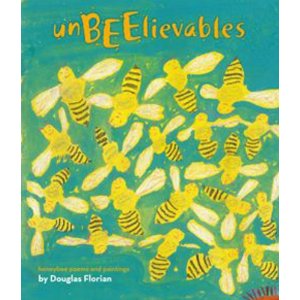
Free Choice Poetry - UnBEElievables: Honey Bee Poems and Paintings

1. Bibliographic Citation
Florian, Douglas. 2012. UnBEElievables: Honey Bee Poems and Paintings. New York: Beach Lane Books. ISBN  9781442426528

2. Summary and Review
UnBEElievables takes a poetic look at the fascinating lives of honey bees. Through a series of poems about honey bees, Douglas Florian has created a fun and educational book about bees. The fourteen poems in this collection range from poems about the different types of bees in the hive including drones, workers, and the queen to bee anatomy and the disappearance of honey bees, known as Colony Collapse Disorder. The poems are all rhyming and short, no longer than one page, and each have a full page illustration on the facing page. Florian’s signature style of paint and collage on paper bags continues delight readers with hilarious illustrations of the queen bee with crown, scepter, and cell phone and the drone brothers dressed in hip hop garb. The collection also includes educational poem/illustration pairings such as “Bee Anatomy” showing the honey bee body parts and “Bee-Coming” showing the honey bee life cycle metamorphosis. Each page contains an interesting paragraph explaining the scientific facts behind each poem. There is a “BEEbliography” included at the end as well as URLs for further reading. I had the pleasure of hearing Florian read some of these poems aloud at the TLA conference, and he did a fun call and response with “Drone” and “Worker Bees.” What a treat to hear him read his poetry! One of my favorite poems in the collection, “Bees Buzz,” makes fun use of onomatopoeia, repetition, and rhyme:

Bees Buzz

All day we bees
Just buzz and buzz.
That’s what we duzz
And duzz and duzz.
Why are we full
Of fuzz and fuzz?
Bee-cuzz bee-cuzz
The fuzz the fuzz
Helps pollen stick
To uzz to uzz.

3. Awards/Reviews
*Positive Reviews in School Library Journal, Kirkus Reviews, The Horn Book, and Publishers Weekly

4. Activities
Being so grounded in scientific fact, this book can be used in conjunction with science. I, myself, learned so much about honey bees while reading it. I would divide the class into three groups - workers, drones, and queens. After reading their respective poems in the book and doing some further research, they would create adaptations of “bio poems” about each type of bee. The poems could then be read to the class and/or posted in the hall. To make it even more fun, the library could hold an “UnBEElievable” fun day in which students could dress up as bees and read Florian’s poems to one another or to other classes. They could also do some research on Colony Collapse Disorder and provide facts on what can be done to help. Educational and fun!

5. Related books
*Insectlopedia by Douglas Florian ISBN 9780152163358
*The Beautiful Bee Book by Sue Unstead ISBN 9780769644288
*The Beeman by Laurie Krebs ISBN 9781846862601

Poetry by Kids - Things I Have to Tell You: Poems and Writing by Teenage Girls

1. Bibliographic Citation
Franco, Betsy. 2001. Things I Have to Tell You: Poems and Writing by Teenage Girls. Cambridge: Candlewick Press. ISBN 9780763610357 

2. Summary and Review
Things I Have to Tell You is a collection of poetry and some prose written by teenage girls and compiled by Betsy Franco. The majority of the book is free verse poetry but some poems rhyme. The topics of the poetry range from body image issues to family issues to drug abuse to relationships and sex. The writing is raw and represents a variety of cultures and races. There are several poems by 16 year-old Miriam Stone, one of the strongest writers in my opinion. Her poem “To Live” illustrates the struggle of a teenage girl to make it through high school while trying to realize her true self. 15 year-old Lisa Woodward’s “My Ode to Crank” eloquently paints a real life picture of drug addiction. Nina Nickels’s unposed black and white photos were not taken to illustrate the individual poems but lend realness to the words. Teenage girls will see themselves in these poems and realize they are not alone in their feelings and struggles. Below is an excerpt of one of my favorite poems in the collection, Miriam Stone’s “A Bad Hair Day.”  

A Bad Hair Day

The day I met you was a bad hair day.
This one piece of hair
Just wouldn’t stay!

You must have noticed,
You must have seen,
Because although you weren’t rude,
And although you weren’t mean,

You were just a little distant,
Your mind another place,
You weren’t interested in me,
I could see it in your face.

***
It’s scary to me
That my future could lay
On one piece of hair
That just wouldn’t stay.


3. Awards/Reviews
*YALSA Best Books for Young Adults, 2002
*Young Adults’ Choices, 2003
*Positive reviews in Booklist, Kirkus Reviews, and School Library Journal

4. Activities
We have all had that pesky bad hair day. I love Miriam Stone’s tongue-in-cheek poem that blames her bad hair day on not getting the guy. What else can we blame a bad hair day for? After reading this poem, students can brainstorm a variety of things that could be blamed on a bad hair day. Students can write a poem blaming that wayward hair for a situation gone wrong then share with the class if desired.

5. Related books
*You Hear Me? Poems and Writings by Teenage Boys by Betsy Franco ISBN 9780763611590
*Paint Me Like I Am: Teen Poems from WritersCorps by Bill Aguado and Richard Newirth ISBN 9780064472647
*Tell the World by WritersCorps ISBN 9780061345043

Janeczko Poetry - Dirty Laundry Pile: Poems in Different Voices

1. Bibliographic Citation
Janeczko, Paul B. 2001. Dirty Laundry Pile: Poems in Different Voices. New York: Harper Collins. ISBN 9780688162511

 
2. Summary and Review
Dirty Laundry Pile is a collection of 27 poems by different poets including Douglas Florian, Marilyn Singer, Jane Yolen, Kristine O’Connell George, and many more. As Janeczko explains in the beginning of the book, each poem is written from the point of view of an object or animal, including a dirty laundry pile. While some poems caught my interest more than others, the collection itself is a fun mix of persona, or mask poems, as Janeczko calls them. The majority of the poems rhyme, but concrete and free verse poems also make welcomed appearances in this collection. “Washing Machine” by Bobbi Katz makes strong use of onomatopoeia: “Glubita glubita glubita… GLUB/Swizzle-dee-swash – Swizzle-dee-swash.” The words wind around like the motion of the washing machine while describing the sound. Melissa Sweet’s whimsical watercolor illustrations create the perfect pairing for the various poems. The beautifully illustrated dark night sky is an appropriate backdrop for Kristine O’Connell George’s “Old Elm Speaks.” This poem speaks volumes with few words. My favorite, “The Mosquito’s Song” by Peggy B. Leavitt is a fun example of concrete poem in the shape of the mosquito’s proboscis.

The Mosquito’s Song by Peggy B. Leavitt

I sing.                       You Slap.
I mean                       no harm.
There is no cause
for your alarm.
A little drop
is all I ask.
It really is
a simple task.
So please
hold still
at this
juncture,
while I
make
a tiny
P
U
N
C
T
U
R
E
!

3. Awards/Reviews
*Texas Bluebonnet Award Nominee, 2004-2005
*Bank Street College of Education Best Children Books of the Year, 2002
*Positive Reviews in Publisher’s Weekly, School Library Journal, and Kirkus Reviews

4. Activities
“The Mosquito’s Song” lends itself to call and response reading. Divide the students into two groups. To make it easier, the poem could be retyped and color coded so the groups know when to say their parts and when they should read together. Beginning with the first line, the groups will alternate lines in a call and response manner until the last word “puncture!” which will be read together.     

5. Related books
*Button Up! Wrinkled Rhymes by Alice Shertle ISBN 9780152050504
*Old Elm Speaks: Tree Poems by Kristine O’Connell George ISBN 9780395876114
*Insectlopedia by Douglas Florian ISBN 9780152163358